
The Importance of Hydration: More Than Just Drinking Water
Article Outline
▼Summary
▼Finding Your Hydration Balance
As we explore the importance of hydration, let's consider how it shows up in your daily life. We often focus on complex aspects of health, but proper hydration affects everything from energy and mental clarity to digestion and joint health. In this article, we'll explore gentle ways to reconnect with your body's hydration needs, and create space for your own wellbeing. We'll look at practical strategies to help you find a hydration balance that works for you.
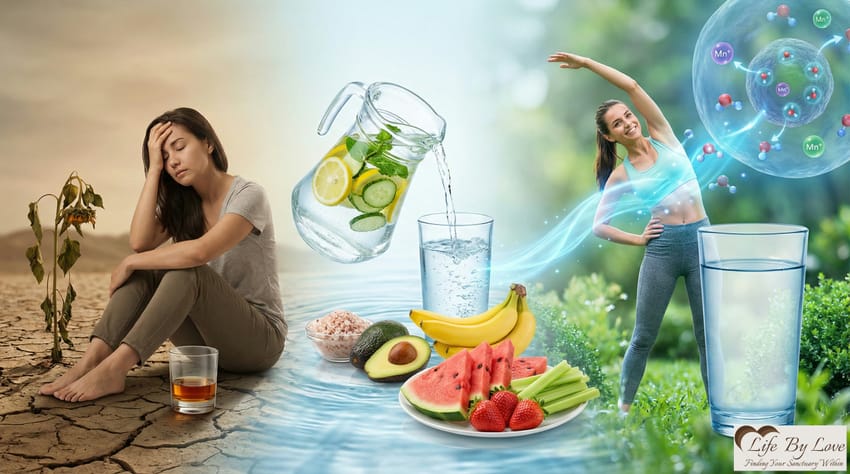
You have probably heard that you should drink more water. But how much thought have you actually given to hydration? It tends to be one of those basics we overlook while focusing on more complex aspects of health. Yet proper hydration affects everything from your energy and mental clarity to your digestion and joint health.
And here is the thing - you can drink plenty of water and still be functionally dehydrated if that water is not making it into your cells.
Why Hydration Matters So Much
Your body is roughly 60 percent water. Every system depends on adequate hydration to function:
Digestion and nutrient absorption. Water is essential for producing digestive juices, breaking down food, and absorbing nutrients. Dehydration contributes to constipation, bloating, and poor nutrient uptake.
Detoxification. Your kidneys and liver rely on water to filter waste and flush toxins. Without adequate hydration, these systems cannot work efficiently, and waste accumulates.
Joint and tissue health. Water keeps cartilage supple and cushions joints. The discs between your vertebrae are largely water. Chronic dehydration contributes to joint pain and stiffness.
Brain function. Your brain is about 75 percent water. Even mild dehydration impairs concentration, mood, and memory. That afternoon brain fog might simply be thirst.
Energy production. Water is involved in cellular energy production. Dehydration is one of the most common causes of fatigue - and one of the most easily addressed.
Temperature regulation. Sweating is your body's cooling system, which requires adequate water reserves.
Cardiovascular function. Blood volume depends on hydration. When you are dehydrated, your blood thickens, your heart works harder, and blood pressure can be affected.
Skin health. Hydration plumps skin cells and supports elasticity. Chronic dehydration shows up in dry, dull skin.
Signs You Might Be Dehydrated
Obvious thirst is actually a late-stage sign of dehydration - by the time you feel thirsty, you are already significantly depleted. Earlier signs to watch for:
- Fatigue or low energy, especially in the afternoon
- Headaches
- Difficulty concentrating or brain fog
- Dark yellow or amber urine (pale yellow is ideal)
- Infrequent urination
- Dry mouth, lips, or skin
- Dizziness, especially when standing quickly
- Constipation
- Muscle cramps
- Cravings for sugar or salt
- Bad breath
Many people live with chronic low-level dehydration without connecting it to their symptoms. They have adapted to feeling suboptimal.
How Much Water Do You Actually Need?
The common advice is eight glasses a day, but this is a rough generalisation. Your actual needs depend on your size, activity level, climate, diet, and health status.
A more personalised guideline is to drink half your body weight in ounces daily as a baseline. If you weigh 140 pounds, that would be about 70 ounces, or just over two litres. Increase this if you are active, sweating, consuming caffeine or alcohol, or in a hot or dry environment.
The colour of your urine is a practical indicator. Pale yellow (like light lemonade) suggests good hydration. Darker yellow indicates you need more fluids. Clear and colourless might mean you are overdoing it and potentially flushing out electrolytes.
Beyond Quantity: Cellular Hydration
Drinking water is only part of the equation. For water to do its job, it needs to get inside your cells - not just pass through your body. This is where electrolytes come in.
Electrolytes - sodium, potassium, magnesium, and chloride - create the electrical gradient that allows water to move into cells. Without adequate electrolytes, you can drink plenty of water but still be cellularly dehydrated. The water passes through without being absorbed effectively, which is why you might drink a lot but still feel thirsty and urinate frequently.
Signs you might need more electrolytes along with your water:
- Drinking lots of water but still feeling thirsty
- Frequent urination of clear, dilute urine
- Muscle cramps despite adequate water
- Fatigue that does not improve with more water
- Headaches that do not resolve with water alone
Practical Hydration Strategies
Start your day with water. You wake up dehydrated after hours without fluids. Drinking one to two glasses of water first thing supports your body's natural morning detoxification processes and sets a good tone for the day.
Add electrolytes when needed. If you are very active, sweating, eating a low-carb diet, or your water seems to run right through you, adding a pinch of quality salt or an electrolyte supplement can improve cellular hydration.
Drink between meals rather than with meals. Large amounts of water with food can dilute stomach acid and digestive enzymes. Sipping is fine, but do the bulk of your hydrating between meals.
Eat hydrating foods. Fruits and vegetables with high water content - cucumbers, watermelon, celery, lettuce, oranges, strawberries - contribute to your hydration while also providing nutrients and fibre.
Reduce dehydrating substances. Caffeine and alcohol are diuretics that increase fluid loss. If you consume these, compensate with extra water.
Make it accessible. Keep water visible and convenient. A water bottle at your desk, in your bag, in your car - the easier it is to drink, the more likely you will.
Set reminders if needed. If you tend to forget, use phone reminders or apps to prompt you to drink throughout the day.
Flavor it naturally. If plain water is unappealing, add slices of lemon, lime, cucumber, or fresh mint. Herbal teas count toward your fluid intake.
The Quality of Your Water Matters
Not all water is equal. Tap water quality varies significantly by location and may contain chlorine, fluoride, heavy metals, pesticide residues, or other contaminants. Consider:
- Filtering your water (carbon filters remove chlorine and many contaminants; reverse osmosis removes more but also removes minerals)
- If using reverse osmosis, remineralizing with trace minerals or electrolytes
- Drinking from glass or stainless steel rather than plastic to avoid chemical leaching
Building the Habit
For many people, drinking enough water is simply a matter of habit. Once you start consistently hydrating, you notice how much better you feel - and you begin to recognise the subtle signs of dehydration before they become significant.
Start where you are. If you currently drink very little water, do not try to immediately drink three litres a day - your body will need time to adapt. Gradually increase your intake over a couple of weeks.
Notice how you feel. Pay attention to your energy, mental clarity, digestion, and other aspects of how you feel as you improve your hydration. The feedback from your own body is the best motivator for maintaining the habit.
Hydration is one of the simplest, lowest-cost things you can do for your health. Sometimes the foundations matter most.
Want to explore other foundational health practises? Learn about simple habits to improve digestion or understand the 6 basic principles for a healthy lifestyle.